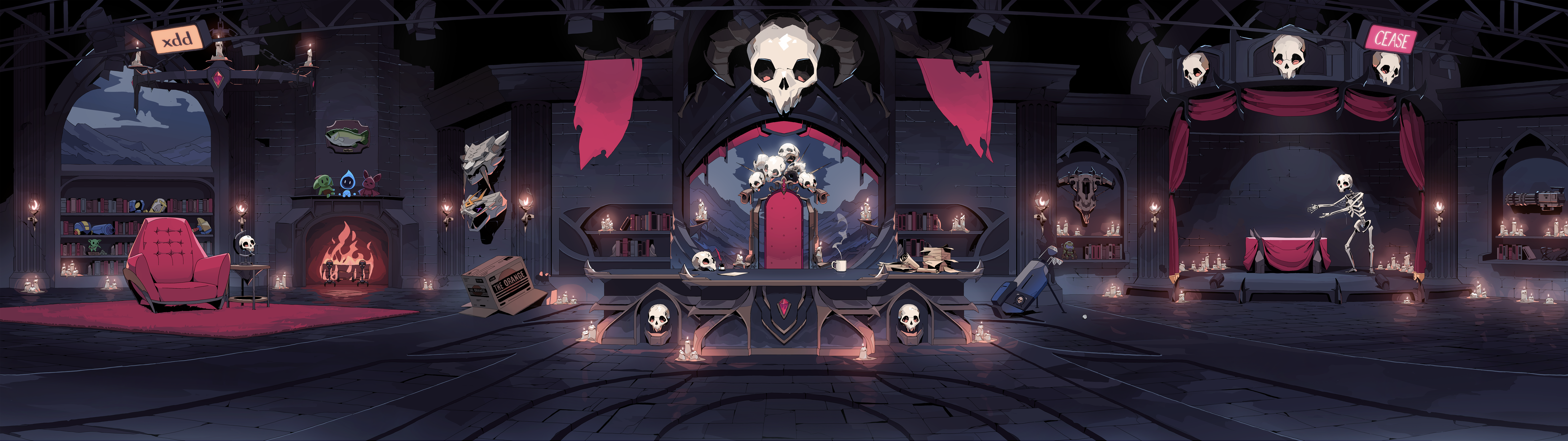
GEEGA Talkshow Background
Client
Software
Photoshop
After Effects
This project is the largest illustration I've made to-date. It's
an animated ultrawide panoramic talkshow set that's made
up of three connected scenes. It was a welcome challenge
and an honor to adapt to a new style while incorporating
GEEGA's branding. There was a lot of strategy in figuring out
the best way to approach an illustration that contains
multiple scenes.
The goal was to have a background that was large enough outside of the main desk scene to pan to objects off-screen. We ended up settling on adding a stage scene for revealing things from behind a curtain, and a lounge scene for a more casual decor that was fit for story time. To pan to objects in other parts of the set, the illustration needed to be a high enough resolution to maintain fidelity while zoomed in. It would also need to be a continuous set where each scene connects to the others.
The goal was to have a background that was large enough outside of the main desk scene to pan to objects off-screen. We ended up settling on adding a stage scene for revealing things from behind a curtain, and a lounge scene for a more casual decor that was fit for story time. To pan to objects in other parts of the set, the illustration needed to be a high enough resolution to maintain fidelity while zoomed in. It would also need to be a continuous set where each scene connects to the others.
My first instinct was to make an extra wide 1-point
perspective illustration. With GEEGA seated right in the
middle it had a funny resemblance to The Last Supper. This
worked well for designing and laying things out, but later
realized that 1-point perspective wasn't adequate for
something this wide.
The farther you get from the vanishing point, the more distorted and stretched the view becomes. Cropping the side of a 1-point perspective illustration feels unnatural and is more of a peripheral view rather than one where you're looking directly at the scene. I experimented with a bulge distortion to curve the sketch towards two new focal points on the sides and found that it better represented camera rotation within a scene. The outer edges felt more like the camera was pointing at another part of the set.
The farther you get from the vanishing point, the more distorted and stretched the view becomes. Cropping the side of a 1-point perspective illustration feels unnatural and is more of a peripheral view rather than one where you're looking directly at the scene. I experimented with a bulge distortion to curve the sketch towards two new focal points on the sides and found that it better represented camera rotation within a scene. The outer edges felt more like the camera was pointing at another part of the set.